

Engraving
Medical abbreviations for your ID, and the ones to avoid
Abbreviations save space, but only the ones responders recognize. Search the list below, then check the ones we recommend spelling out instead.
The short version
- Use an abbreviation only when it is widely known (ICE, NKDA, T1D, AFIB, COPD).
- Spell out anything that could be read two ways. "EPI" can mean epilepsy or epinephrine.
- Write medicines by name: "ON ELIQUIS", not "BT".
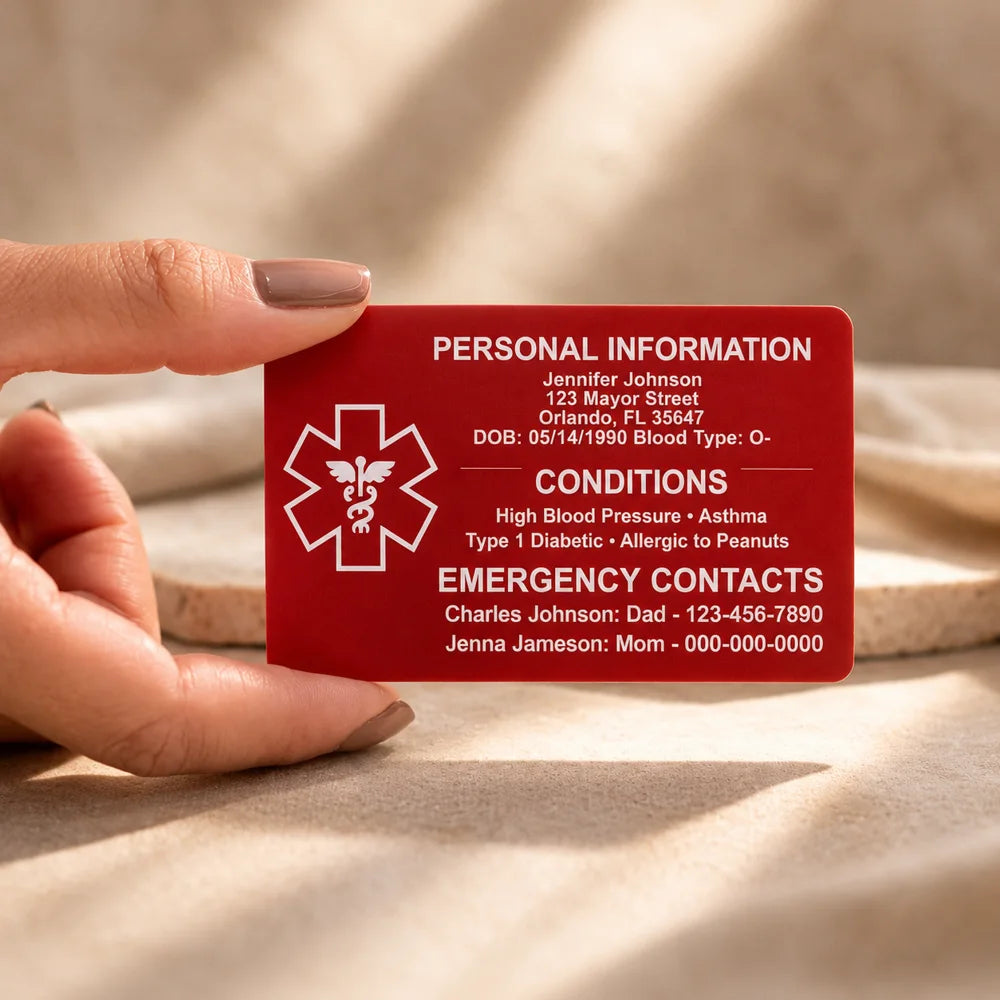
- When space runs out, move details to a wallet card or a QR profile instead of shortening more.
Search the abbreviations
These are abbreviations emergency teams commonly recognize. They are grouped by type; type a word to filter.
| Abbreviation | Meaning | Good to know |
|---|---|---|
| ICE | In case of emergency | Put it before a contact: ICE: MOM 407-555-0123 |
| NKDA | No known drug allergies | Only if it is true. It tells them all medicines are an option |
| NKA | No known allergies | Covers food and environment too |
| T1D | Type 1 diabetes | Widely recognized; add INSULIN or INSULIN PUMP |
| T2D | Type 2 diabetes | Add your medicine if you take insulin |
| IDDM | Insulin-dependent diabetes | Older term, still understood |
| HTN | Hypertension (high blood pressure) | Usually not urgent alone; add it if space allows |
| AFIB | Atrial fibrillation | Pair it with your blood thinner |
| CAD | Coronary artery disease | Add STENTS if you have them |
| CHF | Congestive heart failure | Add any device: ICD, PACEMAKER |
| ICD | Implanted cardioverter defibrillator | Spell PACEMAKER out, it is short enough |
| COPD | Chronic obstructive pulmonary disease | Add O2 if you use oxygen |
| O2 | Oxygen | e.g. COPD ON HOME O2 |
| CKD | Chronic kidney disease | Add DIALYSIS if it applies |
| ESRD | End-stage renal disease | Often paired with DIALYSIS |
| AI | Adrenal insufficiency | Spell it out if you can: ADRENAL INSUFF. |
| MS | Multiple sclerosis | Can be confused with morphine sulfate; spell out when possible |
| PD | Parkinson's disease | PARKINSONS is clearer |
| TBI | Traumatic brain injury | Add how it affects you (MEMORY LOSS) |
| ASD | Autism spectrum disorder | AUTISM is shorter and clearer |
| ADHD | Attention-deficit/hyperactivity disorder | Widely known |
| SCD | Sickle cell disease | SICKLE CELL is clearer |
| VWD | Von Willebrand disease | Bleeding disorder; add your treatment center if needed |
| G6PD | G6PD deficiency | Some medicines must be avoided |
| CF | Cystic fibrosis | Widely known by doctors |
| OSA | Obstructive sleep apnea | Add CPAP if you use one |
| CPAP | Breathing machine for sleep apnea | Important if you need anesthesia |
| CGM | Continuous glucose monitor | Tells them a sensor is on your body |
| PCN | Penicillin | Use with ALLERGY: ALLERGY PCN |
| ASA | Aspirin | Use with ALLERGY or ON |
| NSAIDS | Ibuprofen, naproxen and similar | e.g. NO NSAIDS |
| SULFA | Sulfa antibiotics | e.g. ALLERGY SULFA |
| DNR | Do not resuscitate | Only with your doctor's paperwork; rules vary by state |
| HX | History of | e.g. HX STROKE |
| DX | Diagnosis | Rarely needed on an ID |
| RX | Prescription | e.g. RX LIST IN WALLET |
| W/ | With | Saves 2 characters: T1D W/ PUMP |
Recognition can vary. If you are unsure about an abbreviation, spell it out or ask your doctor.
Spell these out instead
These short forms appear online but can be misread in an emergency. The full word usually fits on one line.
| Avoid | Why | Write instead |
|---|---|---|
| EPI | Epilepsy or epinephrine (EpiPen)? | EPILEPSY · EPIPEN IN BAG |
| BT | Not a standard term | ON BLOOD THINNERS · ON ELIQUIS |
| DM | Can be read many ways | DIABETES · T1D · T2D |
| ALG / ALL | Not standard for allergy | ALLERGY: PEANUTS |
| SEIZ | Not standard | SEIZURES · EPILEPSY |
| ASTH / ASM | Not standard | ASTHMA |
| MS (for medicines) | Morphine sulfate or multiple sclerosis? | MORPHINE · MULTIPLE SCLEROSIS |
Symbols you will see on medical IDs
Symbols help an ID get noticed. They work alongside your engraving, not instead of it.
- The red medical symbol (Star of Life or caduceus): tells everyone this is medical information. Every MiaMia medical ID carries one.
- Heart: often used for heart conditions and devices.
- Drop: often used for diabetes.
- QR code: means there is a digital profile with more details. Learn more in our QR & NFC guide.
Responders rely on words, not icons. Keep your most important line in plain text.
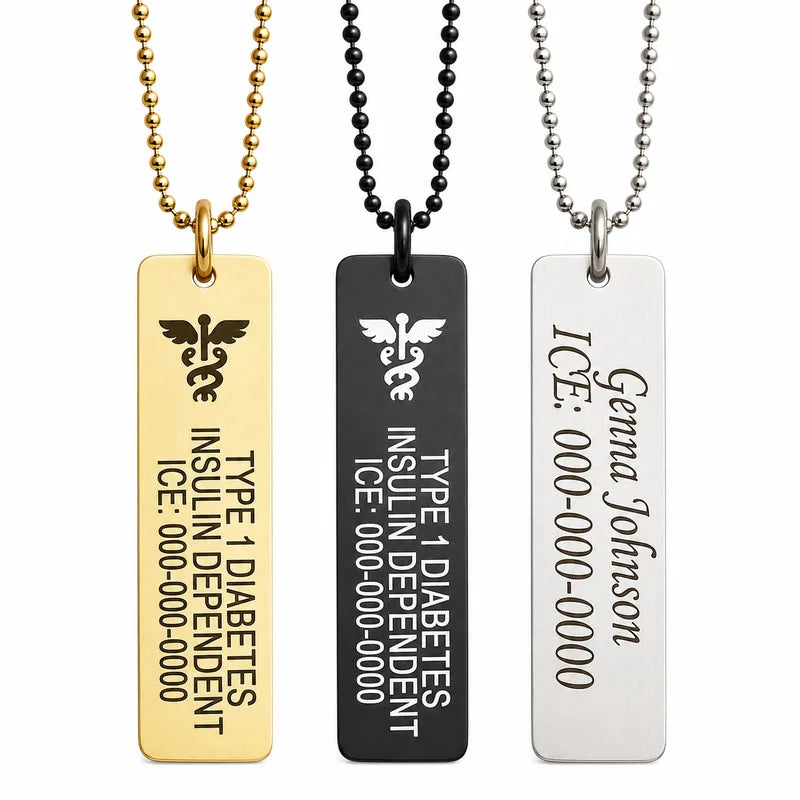
Abbreviations at work
Three tags that stay clear while saving space.
Questions
How many characters fit on a line?
Most MiaMia pieces fit about 20 characters per line, including spaces. Each product shows its own limit, and the planner counts for you.
Should I write ALLERGY or ALLERGIC TO?
"ALLERGY:" or "ALLERGY" followed by the item is shorter and widely understood: ALLERGY PCN, ALLERGY PEANUTS.
Is NKDA worth engraving?
Only if you have no drug allergies and space allows. It is useful information, but your condition and contacts come first.
This guide shares general information to help you plan your medical ID. It is not medical advice. Ask your doctor what is most important to show for your condition.
Shop the guide
Pieces with room for more lines
-
 Women’s Engraved Medical ID BraceletFrom $19.99
-

 Adjustable Medical ID Bracelet 4.7 (3) out of 5 stars$21.50
-

 Unisex Vertical Medical ID Necklace$19.50
-

 Military-Style Medical ID Necklace$18.99
-

 Medical ID Nameplate for Smartwatch BandsFrom $18.50
-
 Personalized Medical ID Wallet Card$14.50
-
 Women’s Medical ID Mesh Bracelet$22.50
-

 Adjustable Sport Medical ID Bracelet$19.99


Questions about your engraving?
Write to our studio. A real person reads every message and helps you decide what fits on your piece.